

Modern contracts like Water-as-a-Service® are set to bring up-to-date treatment where previously unavailable
Whether you’re a city manager, utility director, or developer planning new capacity, understanding the full range of funding pathways is essential.
The traditional ways of paying for water and wastewater infrastructure are alive and well, but new funding and financing options are available for municipalities, private companies, and developers. Grant and loan programs from state and federal agencies have seen an influx of funds, and innovative private-sector contract models are making water and wastewater infrastructure projects happen where they previously were difficult or impossible.
Water and wastewater infrastructure has historically been paid for by local user fees and taxation, state-specific grants, or discretionary set-asides, as well as federal grants or financing structures. But financing for infrastructure, in the form of loans or bonds, requires repayment and often brings long lead times, delays, or political friction. As funding gaps widen and project timelines lengthen, many communities are turning to flexible contracting options—such as leasing, P3s, and Water-as-a-Service®—to deliver treatment capacity more quickly and without upfront capital.
Influx of Water Sector Investment Dollars—But a Persistent Funding Gap
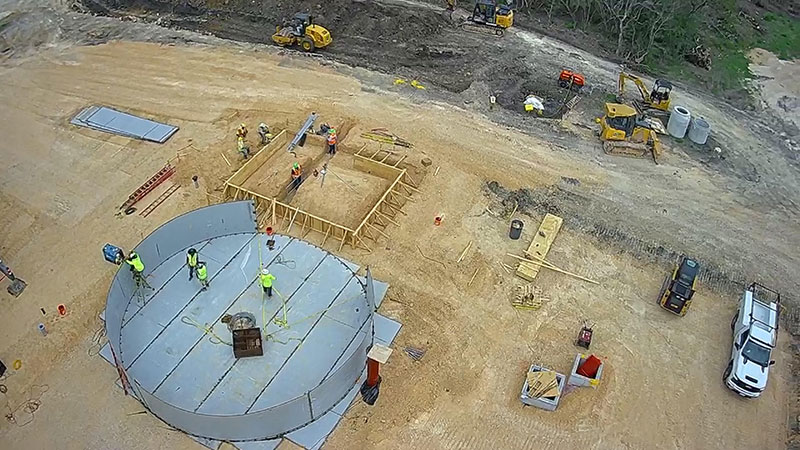
Historic infrastructure investments are flowing through State Revolving Funds, but most communities still struggle to secure the full funding needed to upgrade aging water and wastewater systems.
In the United States, the Bipartisan Infrastructure Bill (BIL) delivered a historic level of funding through State Revolving Funds (SRFs)—the largest investment in drinking water, wastewater, and water reuse infrastructure in American history. Funds are distributed as loans, grants, or principal forgiveness, but securing SRF funding requires detailed applications and rigorous compliance with environmental and engineering standards.
Municipalities, private companies, and developers can also pursue financing from federal agencies, including the EPA and the Department of Agriculture, as well as state water boards. These sources provide important support, yet they still fall short of national needs.
The EPA estimates that $625 billion will be needed to maintain and upgrade U.S. drinking water infrastructure over the next two decades, with another $630 billion needed for wastewater infrastructure.
Despite federal support, local governments still shoulder most capital, operations, and maintenance costs. SRF funding and BIL allocations can help, but they cover only a portion of the total local need, leaving many communities, particularly smaller or rural systems with limited staffing or bonding capacity, struggling to keep pace.
State and Federal Funding Sources
Many funding sources remain available, but most come with a heavy paperwork burden. These programs remain essential tools, but they require significant staff capacity, technical documentation, and long planning horizons.
- State Revolving Funds (SRFs): Low-interest loans, principal forgiveness, and grants administered by state agencies. Highly impactful but competitive.
- WIFIA: The Water Infrastructure Finance and Innovation Act program offers low-interest federal loans for large-scale water projects. Excellent terms, but a lengthy, competitive application process.
- FEMA Hazard Mitigation and Resilience Grants: Target hardening and replacement of vulnerable infrastructure. Application and documentation requirements can be extensive.
- USDA Rural Development Water & Waste Disposal Loans and Grants: A vital resource for rural or unincorporated communities, but requires detailed environmental and engineering documentation.
State-level water boards may provide additional funding, but applicants must navigate state-specific guidelines, deadlines, and priority lists. Grant funding may not cover the full cost of large-scale projects, requiring supplemental financing or scaled-back scopes.
Traditional Financing Models
For decades, municipalities have funded design-bid-build (DBB) water and wastewater infrastructure projects through:
- Bond issues
- Loans
- Levied taxes
- Pay-as-you-go user fees
While well-established, these traditional processes are time-consuming, often involve political risk, and can strain local staff. DBB projects routinely face delays, cost overruns, and administrative burdens tied to compliance, reporting, monitoring, and auditing.
These limitations are driving many communities to consider more flexible alternatives.
Public-Private Partnerships

Public-private partnerships allow communities to leverage private expertise, technology, and financing to deliver modern treatment solutions faster and with reduced operational risk.
To streamline delivery and reduce financial pressure, many communities turn to public-private partnerships (P3s). Structures such as build-own-operate (BOO) and build-own-operate-transfer (BOOT) allow a private provider to assume design, construction, and long-term operational responsibility. These performance-based models can bring needed expertise, maintenance resources, and risk management to communities that struggle with limited staffing or rising compliance expectations.
Short-Term and Long-Term Leasing Options
Leasing, including Seven Seas Water Group’s Lease Plant Program, is an increasingly important tool for municipalities and developers who need water or wastewater capacity but want to avoid the delays, costs, and administrative hurdles of traditional funding.
Leasing allows communities to:
- Add treatment capacity with no upfront capital expenditure
- Avoid impacting bonding capacity
- Install modular systems quickly
- Phase treatment capacity over time
- Use interim solutions while permanent plants undergo expansion or permitting
- Support development growth without committing to a full capital project
Short-term leasing provides immediate relief for peak flows, emergency needs, or construction bypasses. Long-term leasing provides predictable costs while allowing the customer to operate and maintain the system using their own staff. For fast-growing areas or developments, leasing can be a lifeline that keeps projects moving.
Water-as-a-Service® (WaaS®): A Fully Managed, No-CapEx Alternative
While leasing allows customers to operate the plant themselves, Water-as-a-Service® provides a fully managed, long-term service model that includes operations, maintenance, and performance guarantees. Forming a partnership with a professional water and wastewater treatment company can be an innovative solution for overcoming water challenges faced by both rural and urban areas. Seven Seas’ WaaS® cuts red tape and streamlines project delivery by bringing financing, design, construction, operations, and maintenance under a single contract.
With WaaS®:
- Seven Seas finances the project in-house
- Communities pay only for delivered water services
- Performance is guaranteed—no compliance, no payment
- Long-term O&M is included, removing maintenance surprises
- Projects avoid the political and financial challenges of bond issuance
- Infrastructure is delivered faster than traditional DBB
Contract structures include BOO and BOOT, as well as plant acquisitions for existing infrastructure needing rehabilitation or upgrades. WaaS® protects communities from deferred maintenance and provides a predictable, stable path to long-term resilience. Seven Seas maintains a 98.7% plant availability record and a five-star GRESB ESG rating, underscoring reliability in both operations and sustainability.
Choosing the Right Funding Approach
With so many pathways available, communities often blend multiple funding solutions:
- Use SRFs or WIFIA when low-interest financing is available and staff can handle applications.
- Use leasing when speed, flexibility, or limited bonding capacity create obstacles.
- Use WaaS® for long-term, fully managed infrastructure delivered without upfront capital.
- Use P3 structures when sharing risk and long-term operations makes financial sense.
Each tool plays a role depending on project timing, financial constraints, regulatory requirements, and long-term growth projections.
As infrastructure needs accelerate, choosing the right mix of funding tools is essential for cost, compliance, and project delivery timelines. Schedule an assessment with Seven Seas to explore funding pathways that deliver treatment infrastructure faster and without upfront capital.
Image Credit: sorn340/123RF