
Drinking Water Treatment for Fresh, Brackish, and Seawater Sources
Seven Seas Water Group designs, builds, owns, and operates treatment systems that produce safe drinking water and high-purity industrial water. The treatment process is selected around the source water, the contaminants that must be removed, and the required water quality the customer needs.
Fresh Groundwater and Surface Water Treatment: Conventional clarification, filtration, membranes, contaminant removal, and disinfection can be combined to treat fresh groundwater and surface water for municipal, commercial, and industrial use.
Brackish Water Treatment and Desalination: Brackish water reverse osmosis and related pretreatment processes can turn saline groundwater into a dependable drinking water or process water supply.
Seawater Desalination: Seawater reverse osmosis provides a reliable water source for coastal and island communities and industries.
Across these source water types, Seven Seas’ solutions produce 20.1 billion gallons of drinking water annually. Plants can be located close to the point of need and phased to add capacity as demand grows.

Delivering Reliable Service Using Proven, Sustainable Water Treatment Technologies
Seven Seas owns and operates more than 200 plants worldwide with a consistent average of 98.7% plant availability, which is made possible by the most reliable technologies in the business:
Reverse Osmosis
Reverse Osmosis Water Purification: Reverse osmosis (RO) is the most popular desalination technology in the world due to its higher cost-efficiency. In the process, pressurized seawater is forced through a membrane with very small pores (0.001-0.0001 microns) that reject dissolved substances, including salts and minerals. It can purify water destined for domestic taps or industrial applications.
Drinking water purification plants are frequently built around reverse osmosis because the utmost care must be taken with water for human consumption. RO water purification is usually preceded by stages such as coagulation, flocculation, and sedimentation, and can be followed by disinfection. Reverse osmosis is also important to many industries for demineralizing water and meeting the exacting ultrapure water standards of the chip manufacturing industry. RO remains energy-intensive, so lower-pressure membrane processes are a better fit when the higher reverse osmosis standard is not required.
Seawater Reverse Osmosis Desalination: Seawater reverse osmosis (SWRO) is widely used to transform seawater into drinking water or process water. While it is the most energy-efficient desalination process, it remains energy-intensive. Membranes must be cleaned to control fouling, and the concentrated brine left over by the process must be thoughtfully managed to avoid environmental impacts.
Brackish Water Reverse Osmosis Desalination: In brackish water reverse osmosis (BWRO), the lower salt content of brackish water simplifies the process and makes it more efficient. While SWRO plants generally must have coastal access, BWRO can source water from brackish aquifers even far inland. It has been estimated that in the United States, there is more than 800 times more brackish groundwater in aquifers than there is fresh groundwater pumped from aquifers. When BWRO is conducted far inland, however, piping brine to the ocean is not an option, so an alternate disposal protocol must be established.
Other Membrane Processes
Microfiltration: Microfiltration (MF) uses low-pressure membranes with a pore size range of 0.03 to 10 microns to remove suspended solids, frequently as a pretreatment stage before RO or nanofiltration (NF) to control membrane fouling. The process is generally configured either in aeration tanks with vacuum systems or in external pressure-driven membrane units that can take the place of secondary clarifiers and tertiary filtration. The process can remove sand, silt, and clay; giardia lamblia and cryptosporidium cysts; algae; and some bacteria. MF is, however, insufficient on its own for more exacting applications.
Ultrafiltration: Ultrafiltration (UF) uses membranes with pore sizes of 0.002 to 0.1 microns to remove particles, viruses, and microorganisms. It is more effective than MF at removing smaller particles at submicron and colloidal sizes, and can remove dissolved proteins and polysaccharides. UF has a number of advantages over conventional clarification and disinfection processes. It requires a very small physical plant footprint and automation is simple. Chemicals (coagulants, flocculants, disinfectants, and pH adjusters) are not needed to produce a consistent level of particle and microbial removal.
Nanofiltration: Nanofiltration (NF) membranes have a pore size of approximately 0.001 microns to separate dissolved substances including ions and small molecules. It is often used to soften water, and remove color and organic carbon.
Electrodeionization
Electrodeionization: Electrodeionization (EDI) is a water treatment technology that uses DC power, ion exchange membranes, and ion exchange resin to deionize water to a high degree of purity suitable for chip and pharmaceutical manufacturing. EDI is generally used as a polishing stage after RO, operating continuously without chemical regeneration. Instead, the DC current continually regenerates the ion exchange resin. EDI requires pretreatment to control water hardness, silica, carbon dioxide, total organic carbon, chlorine, ozone, and other oxidizers.
Filtration
Multimedia Filtration: Multimedia filters use three or four stages of media to deliver a higher filtering capacity and flow rate than single-media filters of the same size. Generally, multimedia filters require less frequent maintenance than single-media, which tends to lower operating expenses. Multimedia filtration removes particles that cause turbidity, but dissolved iron, manganese, and hydrogen sulfide must be oxidized into solid particles via chlorination or ozonation before they can be removed by a multimedia filter. Multimedia filters must be carefully backwashed on a schedule.
Gravity Filtration: Gravity filtration is a fundamental and widely used water treatment technology that relies on the force of gravity to separate impurities from water. This time-tested method operates simply by allowing water to flow through a porous medium, typically a bed of sand, gravel, or other filtration media. As the water passes through, suspended particles, sediment, and impurities are captured by the medium, leaving behind cleaner, clearer water. Gravity filtration is highly effective in removing larger particles and is often employed as a preliminary step in the water treatment process. It’s appreciated for its reliability, ease of maintenance, and energy efficiency, making it a valuable component in ensuring safe and clean drinking water for communities around the world.
Disinfection
Chloramine Disinfection: Chloramine is a combination of chlorine and ammonia. It is used as an alternative to chlorine and provides longer-lasting residual disinfection, which can help control the growth of pathogens in distribution systems.
Ultraviolet (UV) Disinfection: UV disinfection uses ultraviolet light to disrupt the DNA of microorganisms, rendering them unable to reproduce or cause infections. UV treatment is a chemical-free process and is effective against a wide range of pathogens.
Chlorine Dioxide: Chlorine dioxide (ClO2) is another disinfectant used in water treatment. It is effective against a broad spectrum of microorganisms and has the advantage of not forming halogenated disinfection byproducts (DBPs).
Resilient Water Treatment Plants
Seven Seas understands that as climate change moves forward, the importance of resilience to climate shocks and water risk will continue to grow. We also understand that some of the most serious impacts of disasters are secondary impacts that come from the loss of critical services such as providing water. We know water utilities are on the front lines, so we are innovating to safeguard this vital resource in emergencies.
Our plants maintain the lowest downtime in the industry at 1.3% compared to the industry average of 15-20%, thanks to our computerized maintenance management system (CMMS) that keeps operations and maintenance on track and alerts operators to issues that could develop into failures.

Our Water-as-a-Service® (WaaS®) model incentivizes us to build for durability because we own and operate our plants over the long haul. Our engineers select the most durable equipment from our impressive supplier network developed over the decades.
Deep roots in the hurricane-prone Caribbean have also driven Seven Seas to innovate for resilience. Our desalination plant on St. Thomas in the U.S. Virgin Islands received the first-ever Gold Wind Rating from the U.S. Resiliency Council for structural features that withstand wind and storm surges. The plant was also awarded a USRC Silver Earthquake Rating.
Sustainable Approaches to Water Treatment
Seven Seas Water Group champions sustainable water treatment approaches with a focus on decentralization. This strategy promotes the use of smaller, localized treatment facilities at the point of need, reducing the dependence on long and costly pipelines. This approach offers numerous benefits, including substantial reductions in initial capital expenditures (CAPEX), minimizing operational expenditures (OPEX) associated with pipeline maintenance, and lessening environmental impacts. Shorter pipelines and smaller facilities lead to more sustainable and environmentally friendly operations.
Seven Seas’ innovative Water-as-a-Service® (WaaS®) model stands in stark contrast to traditional infrastructure delivery methods. With WaaS®, financing is provided in-house, alleviating the burden on customers to secure capital independently. Seven Seas takes on the responsibility for plant construction and assumes operational and maintenance risks, offering build-own-operate and build-own-operate-transfer agreements that ensure long-term expertise. Customers simply pay for the water they use at a guaranteed price and quality, eliminating the need for capital procurement, organizational development, and operational complexities. Moreover, the Lease Plant Program provides additional flexibility, allowing for temporary, modular, and customizable options that cater to specific requirements, ultimately promoting cost-effective and sustainable water solutions.
Featured Water Treatment Case Studies
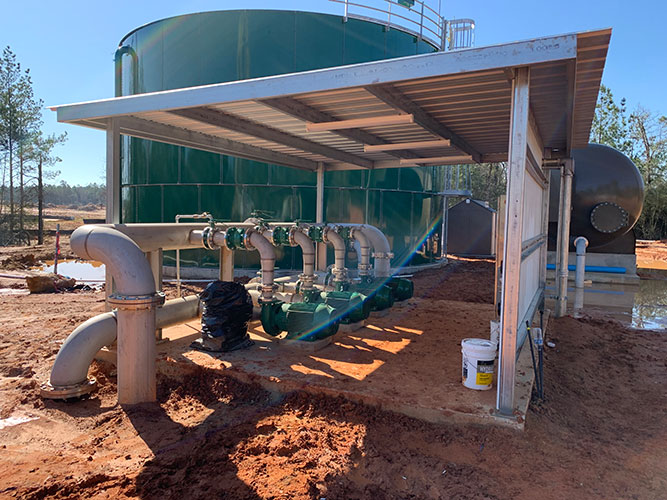
Montgomery County, Texas
For a new community in Montgomery County, Seven Seas delivered drinking water and wastewater infrastructure under a comprehensive lease. During construction, the well was deepened to access enough fresh groundwater to meet the project’s required flow rates. The completed system provides 1.4 MGD of groundwater capacity while consolidating the treatment facilities, site work, and supporting infrastructure under one agreement.

Alice, Texas
Alice, Texas, had long relied on a 20-mile pipeline to supply raw water to its treatment plant. Seven Seas proposed an expandable 3.0 MGD brackish-water desalination plant that will tap a local aquifer, reduce long-term water costs, and improve supply independence. Delivered through a WaaS® agreement, the project required no upfront municipal investment and avoided an estimated $12 million upfront cost of the competing solution.

Point Fortin, Trinidad
Seven Seas fast-tracked a 6.7 MGD seawater desalination plant on a 1.2-acre site in Point Fortin, delivering it just 14 months after permits were issued. The plant treats high-salinity feedwater with elevated suspended solids to provide a reliable municipal water supply while protecting a sensitive marine environment. A build-own-operate (BOO) agreement allowed the project to move forward without an upfront capital investment.

Water-as-a-Service®
Learn more about our turnkey water and wastewater solutions.

Lease Plant Program
Looking for smaller treatment capacities or a lease arrangement? We also offer the option to lease water and wastewater treatment plants or use design-build or design-build-finance models.