
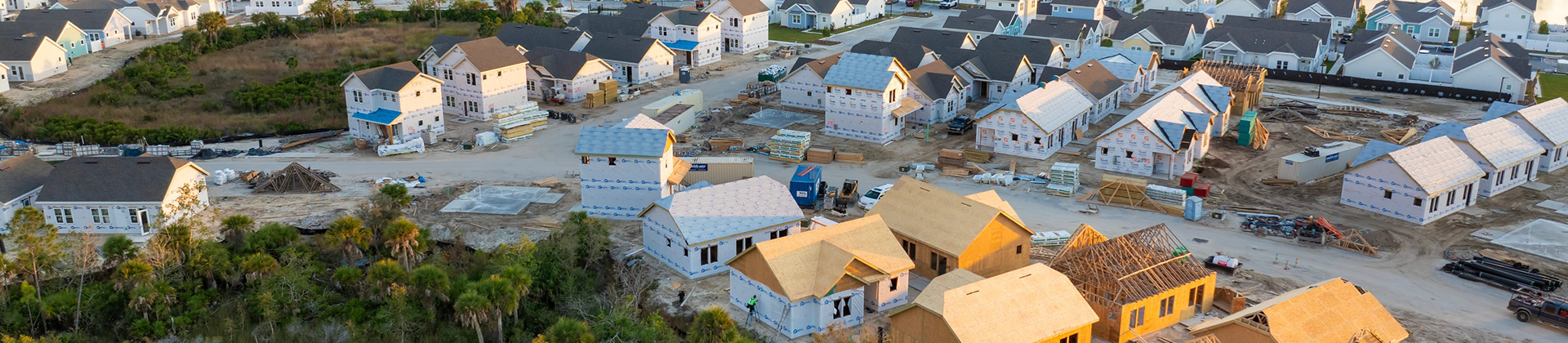
A practical guide to estimating water demand, wastewater flows, peak capacity, and future infrastructure for phased projects
A 500-home development’s water needs can’t be estimated by multiplying 500 by average household use alone. Calculating water and wastewater capacity requires understanding how water will be used, how much wastewater it will generate, and how these demands change.
Development type, expected occupancy, local design criteria, peak demand, irrigation and other water uses, wastewater characteristics, and the timing of buildout all influence how much water and wastewater infrastructure capacity is needed, and when.
Understanding this early can help developers avoid infrastructure challenges that affect project timelines and long-term competitiveness.
In This Article
Start With What Is Being Built
Two developments of similar size can have different water demands and wastewater flows. For example, 500 single-family homes will have different capacity requirements than a mixed-use project with apartments, shops, schools, or other high-demand facilities.
The first step is to establish the type and number of residential units, expected occupancy, commercial or mixed-use components, and any particularly high water demands. These factors show engineers how and where water will be used.
Outdoor water use also matters. Water used for irrigation, filling swimming pools, and maintaining recreational amenities can significantly increase water demand without adding to wastewater flows. Fire-flow requirements must be evaluated separately, because they affect the size of water distribution, storage, and pumping infrastructure.
Estimate Average Water Demand
Engineers use state and local design criteria, utility standards, historical consumption data, and project-specific assumptions to make these estimates.
Engineers must distinguish between average daily demand, or water consumption on a typical day, and seasonal demand, or fluctuations throughout the year. Examples include seasonal tourism and added irrigation in drier months. Engineers must also estimate demand at full buildout to ensure sufficient capacity.
These assumptions and demand factors must align with local utility standards and regulatory requirements.
Account for Peak Water Demand
While average water demand provides a useful baseline, water infrastructure must accommodate periods of higher consumption. Engineers account for these fluctuations by estimating maximum-day demand, the highest volume used in 24 hours during the year, and peak-hour demand, the highest rate of use in a single hour.
Seasonal factors such as increased irrigation or changes in occupancy also raise demand. A system designed only for average daily consumption might struggle during peak periods, leading to reduced water pressure or insufficient supply.
Calculate Wastewater Flow Separately
While water consumption and wastewater flows are closely related, they are not equal. Not all water supplied to a development enters the sewer system. Water used for cooking, washing, and bathing generally contributes to wastewater flows, while most outdoor water use does not.
When calculating wastewater flows, engineers consider several factors:
- Development type and occupancy: Commercial and mixed-use developments have different wastewater flow patterns than residential communities.
- Average wastewater flow: The expected daily wastewater volume based on occupancy, water use patterns, and generation rates.
- Peak wastewater flow: Engineers account for higher flows when sizing collection networks and pumping stations. Treatment plant design also considers flow patterns, pollutant loading, and local requirements.
- Infiltration and inflow: Groundwater can enter sewer systems through cracks, defective joints, and other openings. Stormwater and surface water might enter through drains, sump pumps, or improperly connected drainage systems. Capacity calculations must include these added flows.
- Local design criteria: Utility standards and regulatory requirements establish wastewater generation rates, peaking factors, and allowances for infiltration and inflow used in the calculations.
Water demand calculations determine the supply capacity a development requires, while wastewater flow calculations establish the capacity needed to collect, convey, and treat the wastewater generated.
A Simple Example
Consider a hypothetical 500-home development with 2.5 residents per home. For illustration, assume indoor water use of 80 gallons per person per day. Estimated average indoor water demand would be 100,000 GPD (500 homes × 2.5 residents × 80 GPD).
Assuming 80% of that indoor use returns to the sewer, estimated average domestic wastewater flow would be 80,000 GPD (100,000 GPD × 0.80). If the utility’s planning criteria call for a maximum-day factor of 1.5, maximum-day indoor water demand would be 150,000 GPD (100,000 GPD × 1.5).
This is a simplified example. Actual numbers depend on the project and the utility’s requirements. It also leaves out irrigation, fire flow, peak-hour demand, commercial uses, infiltration and inflow, and wastewater characteristics that affect treatment needs.
Wastewater Capacity Isn’t Only About Gallons
Wastewater treatment capacity depends on more than hydraulic loading, or the volume of wastewater entering a plant. Engineers must consider organic and pollutant loading, including the amount and concentration of contaminants to be removed. A plant might have sufficient hydraulic capacity but lack the capacity to treat higher organic or nutrient loads. This is particularly important for mixed-use developments, where commercial and other nonresidential facilities generate wastewater that requires additional treatment.
Key factors include:
- Organic loading: Restaurants, food-processing facilities, and other businesses can generate wastewater with high concentrations of organic matter, increasing treatment requirements.
- Solids: Wastewater containing suspended or settleable solids might require additional screening or settling processes.
- Fats, oils, and grease: Food-service businesses can generate wastewater with grease that must be managed to prevent sewer blockages.
- Nutrients: Elevated nitrogen and phosphorus levels can require additional treatment to meet discharge permit requirements and limit environmental impacts.
- Other characteristics: Certain commercial and industrial activities can introduce chemicals, detergents, or other substances that require additional treatment.
Initial Capacity and Ultimate Capacity May Be Different
Many developments are built in phases, sometimes taking several years to reach full buildout. As a result, the initial phase might need considerably less capacity than the final phase. Developers and engineers must consider first-phase capacity, the expected pace of new connections, the timing of intermediate phases, and the development’s anticipated final needs.
How quickly new homes and commercial properties will be occupied can be difficult to predict. Building for ultimate capacity up front can tie up capital in infrastructure that is underused for years. But undersizing might require costly, premature expansion if demand increases faster than anticipated.
Can Treatment Capacity Be Added in Phases?
One approach is to phase infrastructure expansion to match development, adding treatment capacity as demand grows. This can involve reserving adequate land and supporting infrastructure.
Developers and engineers can set triggers for when additional capacity is needed. Prefabricated or expandable treatment systems can help align expansion with growth.

The Harris County wastewater treatment plant expanded in phases as the residential development grew.
Seven Seas Water Group has experience supporting phased development through scalable wastewater treatment infrastructure. For example, a development project in Harris County, Texas, used a plant designed to expand in four stages:
- Phase 1: 75,000 gallons per day (GPD)
- Phase 2: 150,000 GPD
- Phase 3: 300,000 GPD
- Phase 4: 600,000 GPD
Through a phased lease arrangement, the developer didn’t have to fund the full system up front.
Check the Calculation Against the Infrastructure That’s Available
Once water demand and wastewater flows have been estimated, the next step is to compare those requirements with existing utility capacity. For water, this means evaluating supply and allocations, distribution capacity, storage, and pumping capabilities. For wastewater, engineers must assess sewer conveyance and treatment capacity.
Developers must also determine whether planned utility improvements will be completed in time to support the project’s anticipated growth. Having a water or sewer connection nearby does not mean sufficient capacity will be available. For developments located beyond a utility’s service area, identifying who will provide the necessary water infrastructure also matters.
Size for the Development You Expect and Plan for the One It May Become
Effective planning requires more than a single capacity figure in millions of gallons per day. Developers and engineers must consider how water demand and wastewater flows will change so infrastructure can serve each phase.
Where utility capacity is unavailable or doesn’t align with the development schedule, Seven Seas can help developers implement phased water and wastewater infrastructure. Through its Lease Plant Program and Water-as-a-Service® offerings, Seven Seas offers ways to align capacity with development needs.
Contact Seven Seas to discuss a water and wastewater infrastructure solution designed around your development’s requirements and anticipated growth.
Image Credit: bilanol/123RF