
Industrial water and wastewater systems need to perform, but does that mean manufacturers need to own them?
Manufacturers need reliable water and wastewater treatment, but that does not automatically mean they need to own the infrastructure that provides it.
Historically, many facilities either relied on municipal utilities or built and operated their own treatment systems. Today, both approaches can create challenges. Utilities may struggle with industrial flows, capacity limitations, or rising costs, while self-owned systems require significant capital, staffing, maintenance, and compliance oversight.
Water-as-a-Service® offers a third option: dedicated treatment infrastructure without the burden of ownership.
In This Article
Owning Critical Infrastructure Is Not Always Necessary
For many industries, energy services, industrial gases, waste management, logistics, cloud computing, and data infrastructure are all essential to production, but companies routinely rely on specialized providers when they can deliver stronger reliability, clearer accountability, better capital efficiency, or deeper technical focus.
For example, facility teams use energy providers when they want infrastructure performance without having to manage every piece of equipment themselves. In energy-as-a-service models, a provider may purchase, install, own, and manage equipment, while the customer pays for measured service outcomes rather than owning the system directly.
It’s the same with wastewater and water treatment. Customers need dependable utility performance, but that doesn’t always require ownership. Relying on a provider for service is becoming a normal business decision as water systems grow more technical, more expensive, more closely tied to compliance, and harder to staff.
Companies routinely outsource these functions not because they are unimportant, but because specialized providers can often deliver them more efficiently and predictably than internal teams.
What Has Been Changing?
Historically, manufacturers could treat water and wastewater as background utility functions. If a local utility could provide service at a manageable cost, the facility used it. If an on-site treatment system already existed, the plant kept it running. Water was essential, but it rarely required significant strategic attention.
That assumption has changed. In many markets, utilities are facing aging infrastructure, capacity constraints, regulatory pressure, and growing operating costs. Industrial facilities with high-strength wastewater may encounter pretreatment requirements, surcharges, discharge limitations, or capacity restrictions that make traditional utility service less predictable and more expensive.
At the same time, self-owned treatment systems have become more demanding to operate. Facilities must manage capital upgrades, regulatory compliance, staffing challenges, maintenance programs, monitoring requirements, and evolving treatment needs while still focusing on production.
For many manufacturers, the result is pressure from both sides. Utility service may no longer be affordable, available, or aligned with operational requirements, while self-ownership can require significant capital, technical expertise, and management attention.
A Dedicated Utility Model for Industrial Water
Water-as-a-Service® operates more like a dedicated utility whose sole job is to serve the industrial operation’s water and wastewater needs. Unlike a general public utility, the system can be designed around the facility’s specific flow, quality, and compliance requirements. Unlike with self-ownership, responsibility for design, ownership, operations, maintenance, monitoring, and long-term performance is shifted to a specialized water provider.
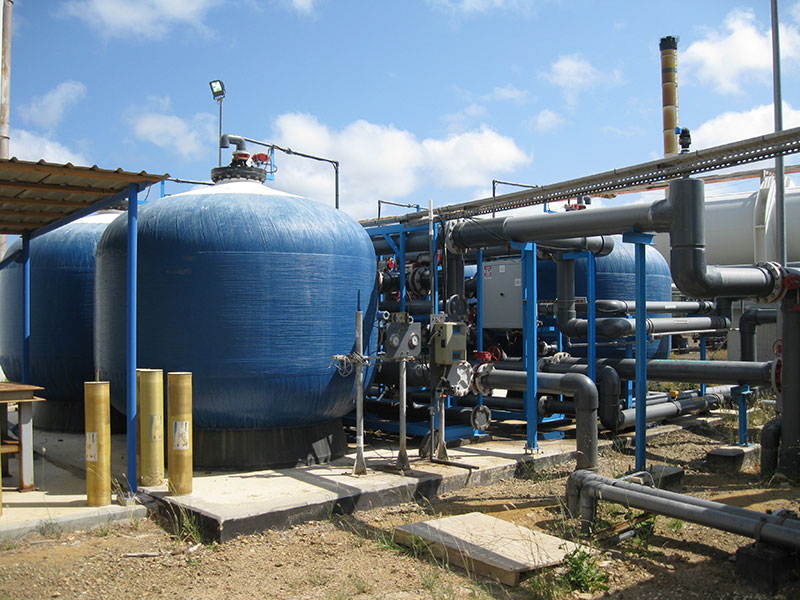
The Curaçao refinery receives a dedicated industrial water supply through a Water-as-a-Service® model, allowing the facility to focus on operations rather than water infrastructure ownership.
Manufacturers are already using this model in situations where water infrastructure would otherwise compete with core business priorities. For example, Seven Seas Water Group owns and operates a desalination facility that supplies process water to a Curaçao refinery, allowing the customer to secure a reliable long-term water supply without investing in and managing the treatment infrastructure. In another project, Seven Seas developed and operates a dedicated water supply system for a phosphate mining operation, providing the water needed to support production while allowing the customer to remain focused on mining activities rather than water plant ownership and operations.
The customer buys the outcome: a reliable water supply, wastewater treatment, water reuse program, or another managed water service structured around facility requirements with guaranteed capacity, quality, and cost. Depending on the application, Seven Seas can deliver:
- Reliable industrial water supply
- Ultrapure process water
- Industrial wastewater treatment
- Water reuse and recycling systems
- Desalination for alternative water sources
Capital matters, but so do other considerations, including management attention, operating reliability, compliance confidence, staffing resilience, and speed of execution.
From Plant Ownership to Performance
Industrial manufacturers already accept that third parties routinely supply their industrial gases or manage their digital infrastructure, not because they’re unimportant, but because the business simply needs dependable outcomes, not more infrastructure.
As industrial water systems become more complex and expensive, manufacturers may benefit from asking a simple question: Is owning a treatment plant creating competitive advantage, or simply creating another asset that must be financed, staffed, maintained, and upgraded?
To explore whether a managed water service model makes more sense than traditional plant ownership, schedule a consultation with Seven Seas.
Image Credit: khaligo/123RF