
Reliable supply and wastewater capacity are key as companies seek resilient locations
Manufacturers have traditionally chosen operating locations based on workforce, proximity to transportation networks, local tax structures, and incentives. While these factors are important, water availability and wastewater infrastructure are increasingly becoming determining factors in whether a site is even viable, particularly for manufacturers that depend on reliable industrial water and wastewater solutions.
Growing populations, aging infrastructure, prolonged droughts, and increasingly stringent environmental regulations are placing greater pressure on local water systems. A site that appears attractive on paper might have hidden limitations if its water supply is uncertain or its wastewater infrastructure lacks capacity for growth. Large manufacturers increasingly evaluate water risk alongside labor availability, transportation access, energy reliability, and permitting requirements. For companies making investments expected to operate for decades, uncertain water supplies or constrained wastewater infrastructure can represent significant operational and financial risk. As a result, water has become a strategic consideration during site selection rather than an issue addressed later in project development.
In This Article
Reliable Water Supply Is No Longer Guaranteed
Water has always been essential for manufacturing and, for the most part, has been available. But this assumption is becoming less certain. For water-intensive industries such as food and beverage production, pharmaceuticals, and electronics manufacturing that depend on consistently large volumes of high-quality water, even short interruptions in supply can disrupt production schedules, affect product quality, and increase operating costs.
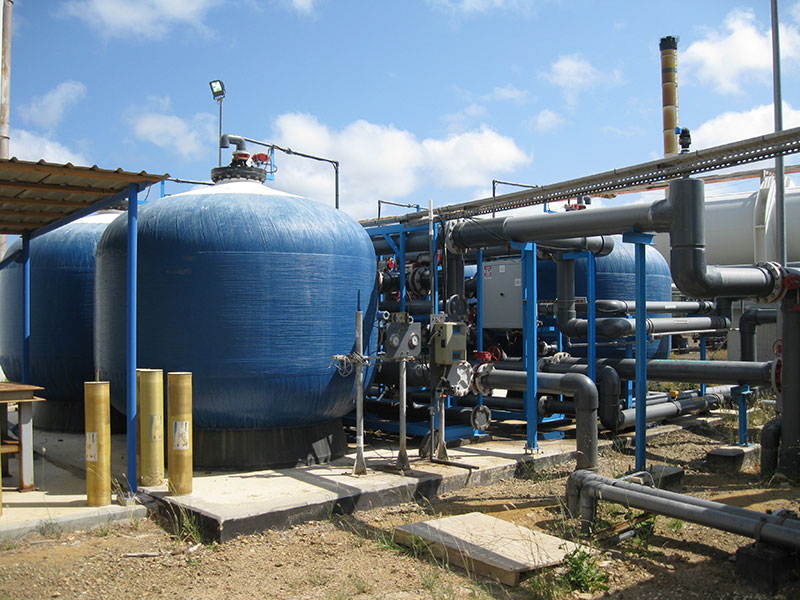
The Curaçao refinery receives a dedicated industrial water supply through a Water-as-a-Service® model, allowing the facility to focus on operations rather than water infrastructure ownership.
The importance of reliable industrial water supplies is evident in real-world operations. When Curaçao Refinery Utilities (CRU) struggled to meet the water demands of Isla Refinery because of downtime and unscheduled maintenance affecting its existing desalination facilities, Seven Seas Water Group rapidly deployed emergency reverse osmosis capacity. Over time, Seven Seas expanded and assumed additional treatment capacity under a 10-year build-own-operate-transfer agreement, ultimately providing nearly 4.9 MGD of industrial-quality water. The project strengthened water reliability and helped reduce the refinery’s exposure to costly production disruptions.
Several trends are making reliable water supplies difficult to secure. Population growth is placing greater demand on municipal water systems, forcing communities to balance residential needs with commercial and industrial ones. In many fast-growing regions, water supply and treatment capacity limits are being reached more quickly than anticipated. At the same time, prolonged droughts, shifting weather patterns, and declining groundwater levels are making water supplies less predictable, even in areas that have not historically suffered from water scarcity.
Manufacturers must also compete with agriculture, energy producers, and data centers for limited water resources. As a result, site selection decisions increasingly hinge not only on whether adequate water is available today but also on whether supplies and capacity will be available throughout a facility’s lifespan. Many manufacturers now evaluate long-term water reliability in the earliest stages of site selection, rather than treating water as a utility issue to be addressed after land has been purchased.
Wastewater Capacity Can Be Just as Important as Water Supply
While water supply often receives the most attention, wastewater infrastructure can pose an even greater obstacle to industrial development. A community might have adequate water resources but lack sufficient wastewater treatment capacity to support new industrial users. Treatment plants operating near capacity, discharge restrictions, infrastructure upgrades, and extended regulatory review timelines can all delay projects, sometimes for years. For manufacturers working to meet tight schedules, those delays can significantly influence site selection decisions. Communities with available wastewater capacity, or the ability to expand it quickly through flexible infrastructure solutions, are often better positioned to attract new industrial investment.
Reuse and Alternative Water Sources Are Becoming Competitive Advantages
As water supplies become constrained, manufacturers are turning to alternative sources to build in greater long-term water resilience. Alternative supplies such as reclaimed water and desalinated brackish groundwater can supplement freshwater supplies, reducing pressure on local resources and providing a more reliable source for industrial processes.
These approaches can reduce dependence on constrained municipal infrastructure, provide greater operational control, and create additional flexibility as facilities expand. In some situations, decentralized water and wastewater infrastructure can further strengthen resilience by allowing manufacturers to treat, reuse, or manage water closer to the point of use, reducing reliance on centralized infrastructure that may have limited capacity.
Manufacturers Are Looking Beyond Utility Rates
Historically, water-intensive manufacturing companies were often drawn to locations with lower water costs. Today, many recognize that the cheapest water does not necessarily represent the lowest long-term business risk.
Site selection teams are increasingly asking broader questions that focus on long-term operational risk rather than simply comparing utility rates.
- Can local infrastructure support facility expansion?
- Is the water system reliable during droughts and peak demand?
- How predictable are regulatory requirements, and how are they likely to evolve?
- Is there sufficient flexibility to expand wastewater capacity as production grows?
- Can operations continue without major disruptions if water demand increases?
Reliable water and wastewater infrastructure often provides greater long-term value than marginally lower utility rates, particularly for facilities expected to operate for several decades.
Communities That Plan Ahead Will Be Better Positioned for Growth
As manufacturers weigh where to invest, water availability is turning from a utility consideration into a strategic business decision. Communities that proactively expand water and wastewater capacity, invest in alternative water supplies, and embrace decentralized and flexible infrastructure strategies will be better positioned to compete for future industrial investment.
For manufacturers evaluating new facilities or communities planning for industrial growth, Seven Seas Water Group delivers scalable water and wastewater infrastructure, including decentralized treatment and Water-as-a-Service®, that accelerates deployment, supports future expansion, and improves long-term water resilience.
Contact Seven Seas to learn how these flexible solutions can help reduce infrastructure constraints and support long-term industrial growth.
Image Credit: unusual111/123RF