
Georgia communities are making water availability, cooling design, and infrastructure capacity part of the data center approval process
At a packed public hearing, the Floyd County Board of Commissioners passed an ordinance Aug. 24 that adds water availability and cooling system design to the data center approval process, which is often dominated by power availability.
The board prioritized closed-loop cooling, required reclamation and reuse systems for water-cooled equipment, and required developers to prove that they chose the least water-intensive cooling technology feasible for the site. It also banned data centers from using private wells or direct connections to surface water or aquifers and mandated public sewer service.
The county’s actions make water planning a requirement before development approval. Before greenlighting a data center project, Floyd County will now need to know where the water will come from, how the cooling system will conserve it, and whether the municipal infrastructure can meet the demand.
Most residents who spoke at the hearing supported the ordinance, although some believed it did not go far enough.
In This Article
Cooling Design Shapes Infrastructure Demand
Data center water demand varies substantially depending on how a data center cools its IT equipment. While data centers with evaporative systems can be water-intensive, closed-loop systems recirculate water and need relatively little replenishment. Air-cooled systems may reduce onsite water use further, but every project has to balance water demand with power requirements, climate, facility design, and operating needs.
For local governments and utilities, those technical differences can influence the capacity discussion. Can existing water supply and treatment systems serve the center without limiting future users? How will the facility affect the public system during peak demand? What wastewater, reclamation, or reuse infrastructure or upgrades will the center need?
By requiring developers to choose the least water-intensive cooling technology feasible for the site, Floyd County pushes consideration of water earlier in the timeline.
Planning a data center where water capacity may be a constraint?
Seven Seas can help evaluate water sources, treatment, reuse, and infrastructure options early in site planning.
Still exploring? Learn more about our Georgia water and wastewater solutions →
Georgia Communities Are Asking Similar Questions
Similar actions have surfaced elsewhere in Georgia. Augusta is developing a comprehensive data center ordinance with proposed standards that will address utility coordination and infrastructure capacity. Walker County has taken closed-loop cooling requirements under consideration along with water use thresholds, filtration, and utility rate changes to fund infrastructure improvements, with the committee citing Floyd County’s ordinance as a model.
Data centers are adding another layer to broader questions about water infrastructure and growth in Georgia.
Growth Without One-for-One Freshwater Demand
Data center growth does not have to create a one-for-one increase in potable water demand. For instance, reclaimed wastewater can replace drinking water for cooling applications, a strategy Augusta Utilities has explored for supplying a proposed data center. The approach could avoid potable water use for cooling while reducing the amount of wastewater discharged into the Savannah River under the city’s wastewater permit.
Onsite treatment and reuse can apply the same principle within a facility, providing greater control over cooling water quality while cutting withdrawals and discharges. The right technologies will depend on influent parameters, available utility capacity, effluent quality targets, and operating profile.
Developers need to ask how much new freshwater demand the project can avoid and what infrastructure will be needed to make that possible.
Addressing water needs early creates more room to evaluate reclaimed water, onsite treatment, reuse, and dedicated infrastructure that keeps pace with project phasing. It can also move planning beyond simply finding enough potable supply. A broader evaluation considers the infrastructure needed to treat and deliver water to the data center, as well as opportunities for efficiency and reuse within the facility itself.
Seven Seas Water Group works with developers and communities to address water sourcing, treatment strategy, reuse, and infrastructure delivery during site selection and power planning. If water availability or infrastructure capacity could affect your data center project, talk with our team about your water and wastewater treatment options.
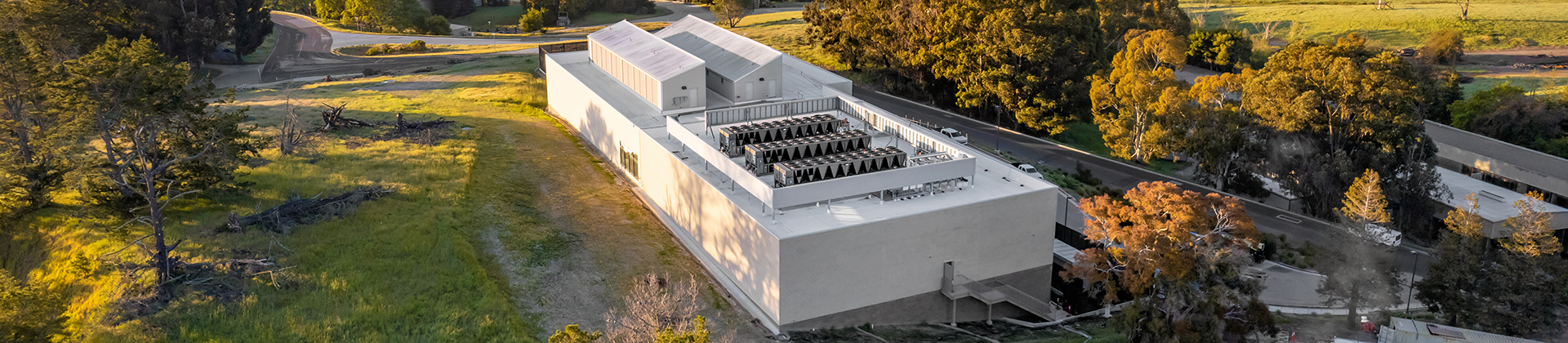
Image Credit: Stanford Research Computing Facility / Wikimedia Commons, CC BY 4.0