
Project Details
Location: Freeport, Texas
Customer: City of Freeport
Solutions: Steel Concentric Wastewater Activated Sludge Treatment Plant
Capacity: 1.6 million gallons per day
Challenges
#1 Replacing aging wastewater infrastructure
#2 Maintaining uninterrupted treatment service
#3 Scaling to a larger concentric treatment configuration
#4 Constructing alongside an operating facility
A new 1.6 MGD concentric treatment plant replaced aging infrastructure while maintaining wastewater service

Freeport sits along the Texas Gulf Coast at the mouth of the Brazos River, where port activity, industry, tourism, and coastal living intersect. This economic diversity places sustained performance and reliability demands on the city’s wastewater infrastructure.
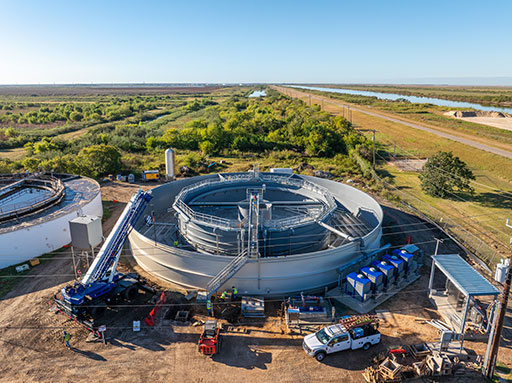
Freeport’s existing wastewater treatment facility was approaching the end of its useful service life and experiencing structural problems. To replace the aging infrastructure while maintaining uninterrupted service, the city moved forward with a new wastewater treatment plant. Seven Seas Water Group, through its Houston-based subsidiary, AUC Group, constructed a 1.6 million gallon per day (MGD) steel concentric wastewater treatment plant featuring an 80-foot clarifier and a 130-foot outer wall incorporating aeration and chlorine contact treatment chambers.
Constructing the new plant alongside the existing facility allowed the city to maintain wastewater treatment service throughout construction.
Maintaining Wastewater Service During Plant Replacement
The project required coordinated site planning, structural precision, and sequencing discipline to ensure continuity of service. The concentric configuration brings clarification, aeration, and chlorine contact treatment together within a circular plant layout.
Construction activities included the erection and assembly of the concentric steel units, integration of process equipment, and alignment of a large-diameter clarifier and its supporting mechanisms.
Building next to an operating plant required careful staging, access control, and safety management. The existing facility remained operational throughout construction, allowing Freeport to maintain wastewater treatment service while the new plant was built.


Scaling to a 1.6 MGD Concentric Wastewater Treatment Plant
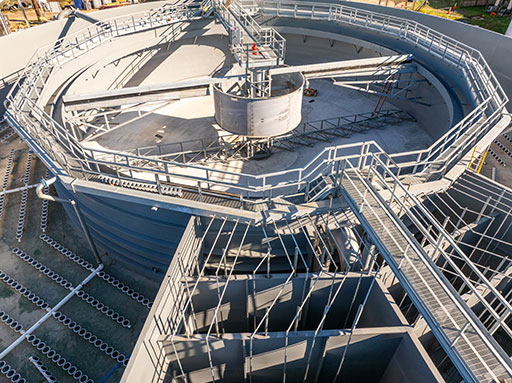
Scaling the concentric treatment configuration to this capacity required adjustments to the plant’s structural design while retaining the proven conventional activated sludge process. The larger installation also introduced additional considerations for material handling and construction.
Moving to an 80-foot clarifier required a structural transition from a bridge-supported to a pier-supported design to maintain integrity at the larger diameter. The treatment process, operating characteristics, and maintenance requirements remained consistent with the established design. While fabrication and installation methods remained largely unchanged, the larger structural components required more substantial material handling and heavier lifting equipment.
The Freeport project progressed from mobilization to commissioning in approximately six months, despite the larger structural components and construction requirements associated with the installation.
Delivering Large-Scale Municipal Wastewater Infrastructure
For municipalities facing aging wastewater infrastructure, projects like Freeport illustrate the importance of planning replacement capacity around existing treatment operations. The new 1.6 MGD facility provides Freeport with updated treatment infrastructure designed to serve the community’s long-term needs.
Beyond conventional design-bid-build approaches, alternative delivery models — including build-own-operate and lease-based structures — allow communities to modernize infrastructure with greater financial flexibility and performance accountability. By aligning engineering execution with long-term operational oversight, municipalities can reduce upfront capital exposure while maintaining regulatory reliability.
To discuss replacing aging wastewater infrastructure, expanding treatment capacity, or maintaining service during plant construction, contact Seven Seas.
Connect With Seven Seas Water Group
Sign up for the latest news and trends in water production and wastewater treatment.