
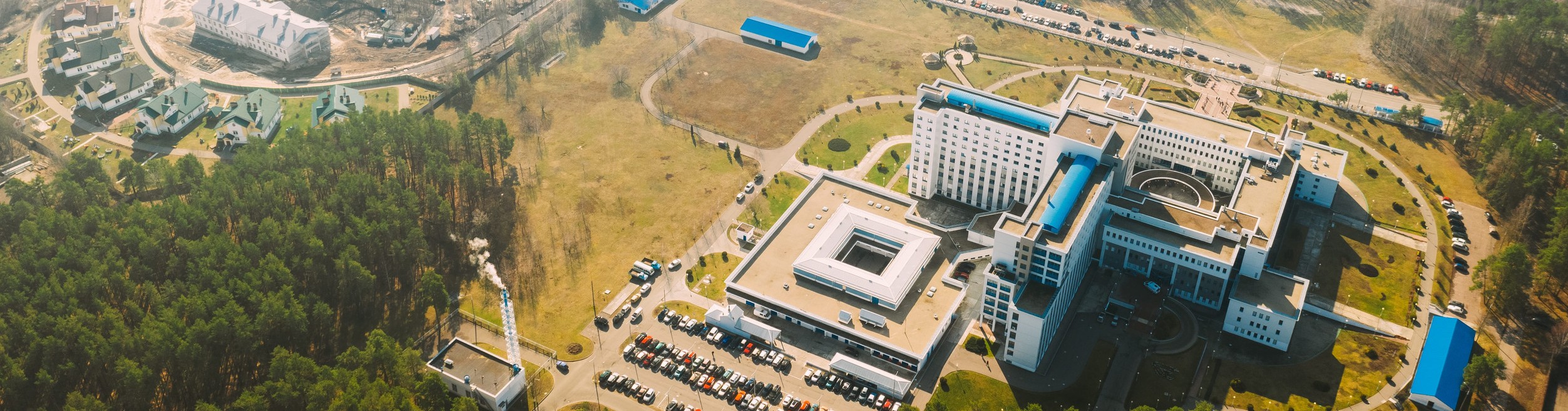
Healthcare systems may be planning for growth while overlooking the infrastructure that supports it
Today’s medical centers are much more complex than traditional hospital buildings. While many began as simple buildings, they have often been expanded to include outpatient centers, surgical facilities, and specialty clinics. Like many industrial facilities, hospital campuses depend on reliable water and wastewater infrastructure to support complex operations and future growth. When expansions are on the drawing board, it’s important to ensure that the underlying water and wastewater infrastructure is adequate to support the plans.
Unlike power supply, water and wastewater capacity are rarely identified as project risks until permitting delays, discharge limitations, or aging infrastructure begin to threaten expansion schedules.
In growing communities, depending on centralized municipal utility systems exposes medical centers to capacity limitations that hospital managers may underestimate. Adopting a contracted utility ownership model can overcome this challenge by removing the infrastructure constraint from the expansion equation.
In This Article
Modern Hospital Campuses Function Like Small Cities
Modern healthcare facilities often offer a variety of medical services in a sprawling collection of buildings that may continue to expand as demand increases. Many medical campuses now operate:
- Outpatient centers where medical treatment is provided to patients who do not require hospitalization
- Ambulatory surgical facilities that provide same-day surgical procedures without the need for hospitalization
- Medical office buildings featuring reception areas and patient examination rooms
- Administrative offices
- Research and laboratory facilities
- Support services and logistics operations
Collectively, these facilities can create a water demand comparable to that of a small city. Water is essential for patient care, laboratory services, cooling systems, food preparation, building operations, and sanitation. Wastewater must be collected, treated, and discharged in compliance with increasingly stringent regulations. As these facilities expand, their demand for water and wastewater services often grows faster than planners and hospital administrators anticipate.
Your Central Utility Plant May Be Older Than Your CIO
Many healthcare campuses rely on utility infrastructure that was designed and built decades ago. Aging chillers, cooling towers, water distribution networks, wastewater collection systems, and other critical mechanical assets often continue operating well beyond their original service life. In many cases, these systems were sized based on patient volume, facility footprint, and water consumption patterns that looked very different than today’s.
Deferred maintenance backlogs can further strain aging infrastructure. As healthcare organizations add new buildings and services, utility systems that once appeared adequate may be operating much closer to their capacity limits than expected.
Why Water Rarely Appears on the Risk Register
Unlike power outages or cybersecurity incidents, water infrastructure challenges tend to remain invisible until they become major issues. Expansion planning often focuses on power, IT, and clinical technology requirements, while water supply and wastewater capacity are frequently taken for granted.
Because water infrastructure operates behind the scenes, its limitations often remain hidden until they begin delaying projects or restricting growth.
The Utility Bottlenecks That Delay Healthcare Growth
In some cases, expansion projects have been approved by clinical, financial, and operational stakeholders who later discover that utility infrastructure can’t support the planned growth. This can result in delayed construction timelines, increased project costs, and difficult capital allocation decisions.
What kinds of problems can pose challenges as medical centers plan to expand? Common constraints include:
- Limited municipal water supplies
- Wastewater discharge restrictions
- Capacity ceilings for central utility plants
- Regulatory requirements
- The need for infrastructure upgrades
- Aging distribution infrastructure
The Growing Compliance Burden on Healthcare Facilities Teams
Hospital utility infrastructure management is becoming more complex as regulatory expectations continue to evolve. Healthcare facilities teams must navigate requirements related to:
- Legionella risk mitigation/ASHRAE 188 water management
- Centers for Medicare & Medicaid Services (CMS) expectations
- Joint Commission surveys and inspections
- Documentation, monitoring, and reporting obligations
These responsibilities require significant time, expertise, and ongoing oversight. Maintaining compliance across increasingly complex utility systems can place considerable pressure on hospital facilities teams already responsible for day-to-day operations.
Clinical Capital Versus Utility Capital
Healthcare executives are often forced into difficult trade-offs between expanding patient care services and investing in the infrastructure that enables those services. Capital budgets often prioritize visible, patient-focused investments, such as new towers, specialty service expansions, advanced clinical technologies, research programs, and community outreach initiatives, over utility upgrades.
While utility infrastructure is essential to hospital operations, it rarely receives the same attention as investments that directly expand patient care. As a result, hospital water infrastructure investments are often put on the back burner until they’re impossible to ignore.
A Different Approach to Utility Infrastructure
An increasing number of healthcare organizations are rethinking how they manage water and wastewater infrastructure, shifting toward long-term utility service models that simplify operations and reduce financial pressure.
These delivery models typically include privately financed infrastructure development, performance-based operations and maintenance, guaranteed availability, regulatory compliance, and scalable infrastructure that can expand alongside future growth.
When hospital water infrastructure is delivered as a service, the utility provider takes full responsibility for designing, financing, owning, operating, and maintaining critical water and wastewater assets. This structure allows healthcare organizations to treat water infrastructure as a managed service rather than a capital burden.
A Service Model for Utility Needs
When healthcare executives meet to plan a hospital expansion project, utility infrastructure should be considered an integral part of planning discussions rather than an afterthought. Evaluating water supply, wastewater treatment, discharge capacity, and long-term utility requirements early in the planning process can help organizations identify potential problems, reducing project risk and avoiding costly delays.
Hospital expansion projects should center around patient needs rather than infrastructure limitations. Seven Seas Water Group’s Water-as-a-Service® (WaaS®) model helps healthcare organizations secure the water and wastewater infrastructure they need without the significant upfront capital investment typically required.
By delivering utility infrastructure as a service, WaaS® helps healthcare organizations remove capacity constraints while reducing the operational burden of owning and maintaining water and wastewater systems.
Contact Seven Seas to learn how the Water-as-a-Service® model can help healthcare organizations expand without water and wastewater infrastructure becoming a barrier to growth.
Image Credit: grigory_bruev/123RF.