
Proven decentralized reuse systems — designed, financed, and operated under Water-as-a-Service®
Water reuse is no longer optional. Seven Seas Water Group delivers water reuse through its Water-as-a-Service® (WaaS®) model, turning wastewater into a reliable, locally controlled supply — faster to deploy, flexibly financed, and operated for long-term performance.
Communities get reuse capacity faster — without taking on design risk, construction risk, or operational burden.
Water recycling can increase usable supply so dramatically that the United States Environmental Protection Agency refers to it as a water resource in its own right — often more reliable than traditional raw water sources.
- Water reuse reduces dependence on constrained freshwater sources
- Reuse-ready infrastructure supports growth without long lead times
- Decentralized water reuse systems align capacity with real demand

Guaranteed Performance and Regulatory Compliance Under WaaS®
Seven Seas delivers complete reuse systems with contractual performance guarantees and full regulatory accountability. Under the WaaS® model, a single accountable partner retains responsibility for design, construction, operations, and compliance — eliminating the coordination and performance risk common in traditional reuse projects.
Seven Seas plants achieve a 98.7% availability rate, with payment tied directly to performance and compliance outcomes. WaaS®:
- Removes traditional barriers to reuse projects
- Offloads risk to Seven Seas by eliminating upfront cost
- Keeps full-service design, construction, and O&M under one roof at a predictable monthly cost
- Assumes all compliance responsibilities
- Eliminates surprise repair costs
While WaaS® is the most comprehensive delivery model for reuse, Seven Seas also offers leasing options when flexibility or interim capacity is the priority.
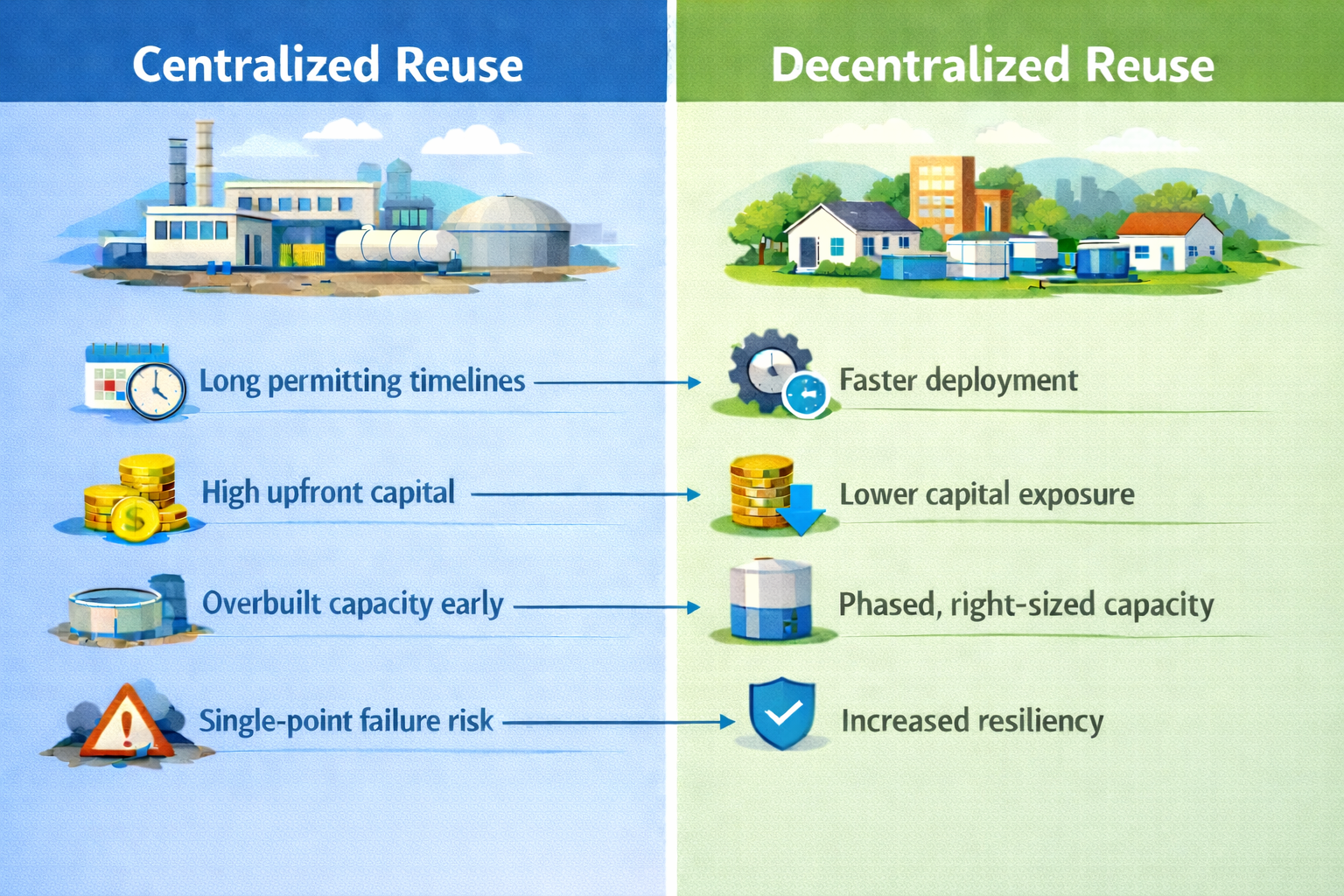
Decentralized Versus Centralized Reuse Systems
Decentralized treatment, or siting appropriately scaled systems at the point of need, keeps water reuse local and lowers ongoing pumping and maintenance costs.
Centralized reuse projects often come with long permitting timelines, complex negotiations, high upfront capital requirements, and capacity that exceeds near-term demand while concentrating risk in a single location.
Decentralized capacity can be phased to match growth, allowing communities to deploy reuse faster, more accurately, and closer to the point of use. Capital exposure shrinks, resilience improves, cross-boundary complexity ends, and systems can expand in step with actual growth.

The Cost of Distributing Recycled Water
When water is treated for reuse at a central plant, how it’s delivered depends on the end use. If it’s treated to potable standards, it can be introduced into the drinking-water system through approved approaches. For nonpotable uses, it’s typically delivered through a separate reclaimed-water (“purple pipe”) network.
Distributing nonpotable recycled water from a central plant can be cost-prohibitive in many cases. It can require building reclaimed-water distribution piping that must meet separation and cross-connection control requirements, resulting in a large upfront expense.
Decentralized reuse changes that equation. Treating and reusing water closer to the point of demand can reduce or eliminate long runs of reclaimed-water conveyance. This is taking on more importance as some locales adopt rules that mandate or encourage use of “purple pipe” systems.
Who Uses Water Reuse Systems
Municipalities
- Extend water supplies
- Meet conservation and reuse mandates
- Add capacity without expanding staff
Developers
- Enable faster project approvals
- Avoid oversized permanent infrastructure
- Support phased development with reuse-ready systems
Utilities & Authorities
- Add reuse capacity without long procurement cycles
- Reduce discharge and supply risk
Water Reuse and Recycling FAQ
What is the difference between water reuse, water recycling, and water reclamation?
How quickly can a water reuse system be deployed?
What technologies are used in water recycling systems?
- Membrane bioreactor (MBR): Provides a compact, high-performance foundation for reuse systems, producing consistently high-quality effluent suitable for a wide range of nonpotable and potable applications.
- Advanced filtration and disinfection: Integrated processes designed to meet reuse standards for pathogens and emerging contaminants.
- Reverse osmosis: Used as a polishing step when applications require the highest water quality.
- Smart monitoring and controls: Enable continuous performance oversight, proactive maintenance, and reliable long-term operation.
Can reuse systems be expanded later?
Is Water-as-a-Service® available for reuse projects?
Water Reuse Case Studies


Request a Quote for a Water Reuse Treatment Plant
Contact Seven Seas to explore the possibilities of water reuse under financing arrangements that are tailored to your needs. Our experts can work with you to design the right combination of treatment technologies for your situation.