

Building in earthquake and wind resistance helps ensure access to safe and reliable water
Seven Seas Water Group is proud to operate the first and only water treatment facility in the Caribbean certified by the U.S. Resiliency Council (USRC) for its ability to withstand wind and earthquakes. This significant achievement not only highlights our commitment to ensuring a continuous supply of clean water but also sets a standard for the region’s water infrastructure.
Not only did the desalination plant for the Harley Power Plant in St. Thomas receive the USRC Silver Earthquake Rating in 2023 due to its high earthquake resilience, but it was also the first facility to receive the USRC Gold Wind Rating due to its innovative and resilient structural design, which minimizes the impact of high winds.
With the Caribbean facing increasingly frequent and severe storms, the importance of resilient infrastructure cannot be overstated. High winds and storm surges from hurricanes and tropical storms can severely damage water infrastructure, leading to disruptions in water supply and sanitation services, which are essential to ensuring public health and supporting agricultural activities, as well as the tourism industry, a major economic driver in the Caribbean. The region is also subject to extensive volcanic and seismic activity, which can have a similar impact on poorly built infrastructure.
Seven Seas understands these unique challenges and is committed to providing reliable water solutions that meet USRC certification standards and can withstand extreme weather conditions and natural disasters.
Our plants in the U.S. Virgin Islands have demonstrated exceptional performance, maintaining operations during extreme weather conditions and ensuring that the communities we serve have access to safe and reliable water.
Testing Design and Construction
The USRC certification is a comprehensive system designed to evaluate and rate the resilience of buildings and structures in terms of their ability to withstand and recover from natural disasters, such as earthquakes or high winds. The certification provides a standardized way to measure and communicate a building’s performance in three key areas: safety, damage, and recovery.
The design and construction of the plant were assessed with several advanced methodologies. A performance-based wind design assessment was conducted to evaluate the building’s main wind force resisting system. This included creating a 3D finite element method (FEM) analysis model using extended 3D analysis of building system (ETABS) to simulate wind forces for 50-year and 3,000-year event wind speeds. The assessment ensured that the facility could withstand severe wind events while remaining operational and safe.
In addition, a drift-damage-index (DDI) check was performed to review components sensitive to deformation. This assessment helped in identifying and mitigating potential structural weaknesses that could impact the plant’s performance during high winds. These evaluations were crucial in ensuring that the facility met the stringent criteria for USRC certification, achieving high ratings in safety, damage, and recovery dimensions.
Advanced Seismic and Storm Surge Evaluations
The seismic evaluation followed FEMA P-58 methodology to assess the probable seismic performance of the building. This included building an analytical model to determine the structure’s fundamental period of vibration, acceleration demand leading to failure, and drift levels at which structural members would be anticipated to yield. These rigorous assessments contributed to the plant receiving a four-star safety rating, indicating that serious injuries would be unlikely during seismic events.
Storm surge evaluations were conducted using ASCE 7 and ASCE 24 standards, considering base flood events and wave heights. The Harley seawater reverse osmosis (SWRO) plant’s design includes elevated structures and erosion control measures to mitigate the risks of storm surges, further enhancing its resilience to natural disasters.
Certification Achievement
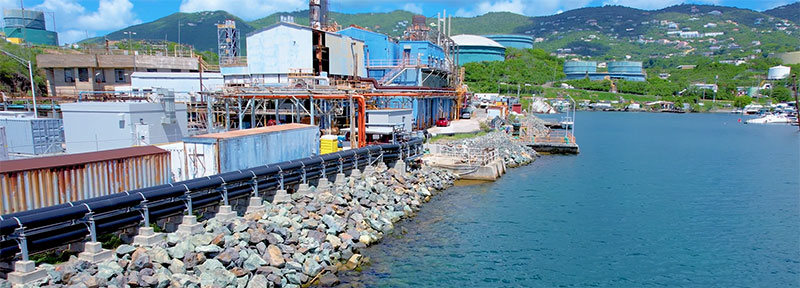
The Harley SWRO Plant in St. Thomas is the Caribbean’s first certified resilient water facility.
The USRC evaluates earthquake and wind resilience based on the three key performance metrics above (safety, damage, and recovery), which are rated on a scale of 1 to 5 stars.
- Safety: A rating ranging from 1 star (low safety) to 5 stars (high safety) is given according to the risk of injury or death as a result of an earthquake or high winds. This is assessed based on the evaluation of the building’s structural integrity, design, materials, and construction method.
- Damage: A rating ranging from 1 star (high damage) to 5 stars (low damage) is given according to the damage the structure may sustain due to an earthquake or high winds. The assessment considers repair costs as a percentage of the building’s replacement cost, covering structural and nonstructural damage, as well as building contents.
- Recovery: A rating ranging from 1 star (long recovery time) to 5 stars (short recovery time) is given based on the estimated time required for the building to become operational after an earthquake or high wind event. The assessment criteria include the time needed for occupants to safely re-enter the building, restore functionality, and fully recover from the disaster.
A Silver Rating is earned with at least three stars in each category, and a Gold Rating requires at least four stars in each category. Facilities with a Gold Rating are expected to suffer minor damage of less than 10% of replacement cost.
Operational Resilience of Water Treatment Plants
Because Seven Seas owns and operates many of the plants it builds, it is in the company’s best interest to ensure the infrastructure is designed and built to the highest standards. Seven Seas’ engineers use robust materials, equipment, and technologies for the construction of all water and wastewater treatment plants, guaranteeing top-quality workmanship, structural integrity, and reliable performance.
Seven Seas’ focus extends beyond buildings to include the equipment they house. Equipment is restrained to make sure it remains functional during and after a natural disaster. All plants are fitted with an advanced performance monitoring and maintenance management system to ensure the plant operates at optimal efficiency and is maintained effectively to limit downtime.
This computerized maintenance management system (CMMS) records critical data, generating reports that provide a clear picture of the plant’s performance, while also alerting operators to anomalies that could be precursors to equipment failures so that they can shut down equipment before any damages occur. The CMMS also allows routine preventative maintenance tasks to be scheduled ahead of time, limiting the risk of unplanned interruptions due to breakdowns.
Seven Seas uses several tried-and-tested standardized designs and keeps an inventory of spare parts readily available to limit downtime. The quality of our plants, together with our efficient backup support service, ensures 97% availability across all our plants globally.
Benefits of Resilient Water Treatment Facilities
Seven Seas’ Harley SWRO plant includes a robust structure designed to withstand winds of up to 185 mph, and its location on higher ground minimizes the risk of flooding. These design features help ensure that the plant can continue operating under extreme weather conditions, providing an uninterrupted water supply during and after natural disasters, when contamination risks are high.
Resilient water infrastructure is essential for the Caribbean when it comes to coping with natural disasters, adapting to climate change, protecting public health, and ensuring economic stability. In a region like the Caribbean, whose economy relies heavily on tourism, having access to a safe, reliable supply of water is critical to providing essential services to visitors and maintaining the attractiveness of destinations. Water infrastructure also supports agricultural activities, which are crucial for local economies and food security. Resilient systems ensure irrigation and livestock watering can continue despite climate challenges, ensuring economic stability and growth.
By prioritizing and investing in resilient water systems, the Caribbean is enhancing its capacity to provide reliable water services, safeguard its communities, and secure a sustainable future. The success of our USVI plants serves as a model for other municipalities and regions facing similar challenges. Contact Seven Seas to learn more about our robust plant designs and innovative water treatment technologies, and how our financing mechanisms like Water-as-a-Service® can provide swift access to reliable water when budgetary constraints pose a challenge.
David Charles is a highly skilled Environmental Engineer with a Bachelor of Science in Environmental Engineering from the University of Cincinnati. Based in Florida, David has accumulated extensive experience through various internships, including roles at Kiewit Corporation in Omaha and Atlanta, and AVCON Inc. in Orlando. He has also served as an Operations Intelligence Analyst in the United States Air Force. David is certified in Environmental Inspections (FSESCI) and is proficient in English and Spanish. His technical skills encompass environmental permitting, groundwater testing, soil sampling, AutoCAD, Bluebeam Revu, and Stormwater Management Model (SWMM). David excels in managing environmental compliance programs, obtaining permits, and coordinating project-wide environmental strategies.