
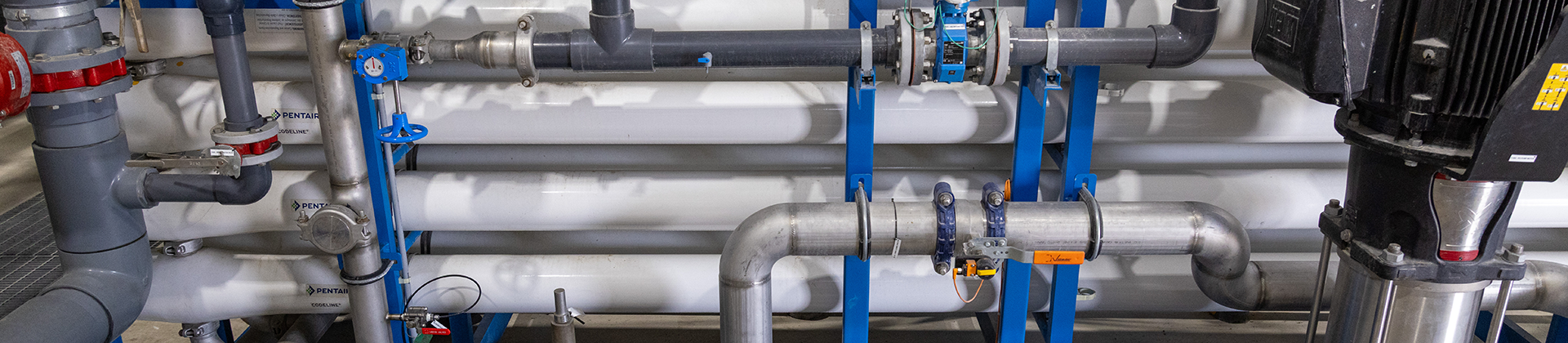
Each type of membrane-based water treatment has pros and cons, so it’s important to get down to specifics of your treatment needs
As demand for high-quality water continues to rise, driven by population growth, industrial demand, and increasingly tighter water quality standards, so does the need for reliable, efficient water treatment solutions. Whether you’re designing a municipal water system, upgrading industrial processes, or planning a commercial project, selecting the right water treatment technology is essential for successfully meeting your water quality goals.
Ultrafiltration (UF) and reverse osmosis (RO) are two of the most widely used membrane technologies in municipal, industrial, and commercial water treatment applications. Seven Seas Water Group designs integrated solutions that leverage the best of each for reliable, high-quality water treatment, but there are some key differences in terms of performance, cost, and application.
While both technologies rely on semipermeable membranes, they serve very different purposes and perform in fundamentally different ways. How can you decide which one is right for your project? Understanding how each works and where each excels can help you choose the optimal solution for your system, ensuring it delivers both in terms of performance and value.
What Is Ultrafiltration?
Ultrafiltration is a membrane filtration process that physically removes contaminants from water as it passes through a semipermeable membrane. UF membranes typically have pore sizes ranging from 0.002 to 0.1 microns, which allow water molecules and dissolved minerals to pass through, while retaining larger molecules such as microorganisms, viruses, silt, algae, and other suspended solids. UF is used in various applications, including water clarification and wastewater treatment, and as a pretreatment, protecting more sensitive downstream systems such as reverse osmosis from fouling and damage.
What Is Reverse Osmosis?
Reverse osmosis is a membrane-based technology that removes contaminants from water as it is forced through a membrane under pressure. Because it uses a semipermeable membrane with much smaller pore sizes, ranging from 0.001-0.0001 microns, RO can remove a wide range of dissolved contaminants that UF can’t, including salts and ions, heavy metals, pesticides, and other impurities.
RO is used in water treatment applications including seawater and brackish water desalination, drinking water treatment and boiler feed water treatment, as well as for the production of high-purity ultrapure water required for many pharmaceutical and industrial applications.
Key Differences Between These Membrane-Based Processes
While UF and RO are similar technologies, there are some differences between them:
- Contaminant removal: UF membranes are capable of removing suspended solids, particulates, and pathogens, while RO membranes, with their smaller pore sizes, take this a step further, removing dissolved solids and salts, as well as contaminants such as metals, organic pollutants, and PFAS.
- Energy requirements: UF systems use low pressure and require less energy than RO systems, which use more energy because of the higher pressure required (however, energy use in RO can be reduced by using energy recovery devices and advanced membranes).
- Water recovery rates: Water recovery rates in UF systems, often > 90%, are higher than those of RO systems, which typically range between 50-75% due to the water loss associated with brine waste.
- Cost and maintenance: UF systems have a lower cost and are easier to maintain, while RO systems have higher operational costs and more complex maintenance requirements due to the need for more frequent membrane cleaning.
- Role in multistage systems: UF is often used as a pretreatment for RO to protect RO membranes and extend their lifespan. RO systems, on the other hand, are typically the final polishing step in high-purity water treatment systems.
Bottom line: UF is great for removing solids and biological contaminants, and RO is essential for removing dissolved substances and achieving high-purity water.
Which One Is Right for You?
Choosing between UF and RO, or deciding to use both, depends on a few critical factors. Here are the key things to consider when choosing which option is best for you:
- Source water quality: Understanding the characteristics of your feed water is essential. If your source is surface water or wastewater with high levels of suspended solids and microbial contaminants, UF is an effective solution for initial treatment. However, if you’re dealing with brackish groundwater or seawater and need to remove dissolved salts, minerals, or contaminants like PFAS and nitrates, RO is typically required to meet those treatment goals.
- Target water quality: Desired water quality also plays a major role. If the goal is to produce clear water that’s free of bacteria and turbidity — for example, for irrigation, cooling towers, or certain industrial processes — UF may be sufficient. For applications that demand a higher level of purity, for example, drinking water, or ultrapure water for applications including pharmaceutical manufacturing, chip manufacturing, or boiler feed water, RO is better suited due to its ability to remove even the smallest dissolved impurities.
- Energy considerations: If your facility has limited energy capacity or you’re aiming for a low-energy footprint, UF may be the more sustainable option. On the other hand, if energy resources are not a limiting factor and water quality demands are high, RO’s benefits often justify the higher energy use.
- Budget and maintenance: UF systems require less frequent membrane cleaning and lower chemical use. RO systems, while offering higher filtration performance, typically involve more complex — and more expensive — operation and maintenance protocols, including membrane fouling prevention, regular monitoring, and brine disposal. Understanding your operational budget and staff capabilities can help guide the right choice.
- Regulatory requirements: If your project must meet strict water-quality standards, such as drinking water regulations, discharge permits, or industry-specific purity levels, RO may be necessary to ensure compliance. For less stringent applications, or where guidelines primarily focus on microbial safety and water clarity, UF may be more than adequate. Always match the technology to the level of treatment your regulations require.
Ultrafiltration and reverse osmosis are both powerful technologies, each with its own strengths and ideal applications. In many cases, UF and RO work best together as part of a multistage membrane system. To determine the ideal configuration, it’s best to consult with a water treatment expert who can evaluate your needs and design a solution that’s efficient, cost-effective, and compliant. At Seven Seas, we specialize in designing and operating custom membrane systems that meet your unique water challenges, whether through packaged systems, or full-scale plant development.
And through our Water-as-a-Service® model, clients can access these technologies without having to outlay any upfront capital, while receiving full-service support for operation, maintenance, and compliance.
Ready to find the right membrane technology for your project? Contact Seven Seas Water Group to explore a solution that fits your water quality goals, timeline, and budget.
Image Credit: Jason Page