

How decentralized systems and WaaS® reduce risk, restore service faster, and build resilience into every layer of your utility operations
As hurricane season ramps up, water and wastewater systems face serious and often underappreciated risks. The Caribbean, Eastern Seaboard, and Gulf Coast have always had hurricanes, but their frequency and intensity have increased. Rather than dissipating after landfall, recent storms have often held together and barreled inland, disrupting communities far from the coast and even in mountainous regions.
Because water infrastructure is often out of sight, it’s easy to forget how fragile treatment plants, lift stations, pipelines, and collection networks can be. Planning with resilient equipment alongside decentralized strategies and modern procurement strategies such as Water-as-a-Service® (WaaS®) can help communities stay afloat, respond more quickly, and minimize damage if a hurricane strikes.
Hurricane Season and the Threat to Water Systems
Hurricane season runs from June 1 through November 30, and forecasters are predicting another active year. The National Oceanic and Atmospheric Administration’s 2025 Atlantic hurricane season outlook anticipates 13 to 19 named storms, six to ten of which may become hurricanes, including three to five major hurricanes.
However, many communities have not hardened their water and wastewater infrastructure. When flooding inundates treatment plants, power outages halt operations, storm surges overpower coastal systems, or pipelines buckle under shifting soils, the consequences can affect public health and economies throughout the entire region. Proper planning and decentralized approaches can contain the impact.
Hurricanes affect water systems with a cascade of threats. When treatment plants and lift stations sit at or below floodplain elevation, rising water can disable pumps and electrical controls, forcing facilities offline, and extended grid failures can keep them offline.
In coastal regions, storm surges can push saltwater deep into freshwater distribution networks and overwhelmed wastewater systems may discharge untreated sewage. High winds and debris can crack water mains or collapse collection lines, interrupting service and introducing health hazards.
The Case for Decentralized Water and Wastewater Treatment
Centralized systems have acute vulnerabilities because they depend on a single, large-scale plant to serve an extensive service area. A failure can leave hundreds of thousands without service, prompting boil-water advisories, disrupting businesses, and straining emergency responders. In contrast, decentralization distributes treatment capacity among systems serving smaller service areas. If one facility is damaged, those effects remain localized.
Restoring a smaller plant can take hours or days rather than months or years because it requires less civil work, uses readily available standard pipe sizes, and needs simpler permitting. More flexible siting for smaller plants allows utilities to take advantage of topography and place them on higher ground. Smaller units also allow for easy, incremental scaling when post-disaster population shifts affect demand.
Additionally, containerized steel units often used for decentralization have faced trials in real storms. Seven Seas Water Group has long championed the benefits of decentralization, providing resilience-focused designs that withstand Category 4 winds and seismic events and that can be sited above surge levels.
How Water-as-a-Service® Enhances Emergency Readiness
Water-as-a-Service® is a concession-like model that includes design, construction, operation, and maintenance without upfront capital costs. Under WaaS® agreements, municipalities and developers can avoid lengthy design-bid-build delays by keeping all aspects of projects under one roof, from design to financing to construction, and through long-term operations and maintenance by water experts.
WaaS® plant options can slash setup time in an emergency. Operators from Seven Seas remain on call before, during, and after storms, securing equipment, maintaining spare parts inventories, and standing ready for emergency mobilization.
Essentially, performance-based WaaS® agreements allow utilities to offload risk while freeing capital and organizational resources, replacing O&M and compliance worries with a regular, easily budgeted bill. Real-world experiences provide powerful lessons, illustrating the critical difference these resilient strategies can make.
Real-World Lessons and Success Stories
Hurricanes like Harvey in 2017 and Ian in 2022 exposed the weaknesses of centralized systems. When Hurricane Harvey struck Houston, ten or more treatment plants went offline, forcing boil-water notices and causing raw sewage discharges that damaged neighborhoods. More than two months after the storm, three Houston plants still remained offline. Ian’s storm surge similarly crippled systems in Florida, spilling sewage and leaving some communities without safe water for weeks.
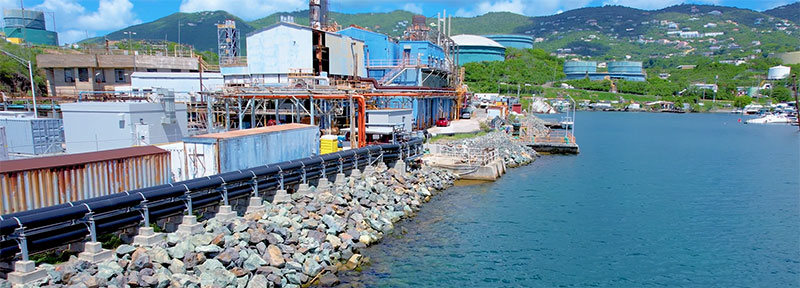
The Seven Seas Water Group plant on St. Thomas was the first to receive a USRC Gold Wind Rating for its resilient design, which anticipates 3,000-year-event wind speeds.
In contrast, Seven Seas has hurricane-hardened its plants and operating procedures while operating many Caribbean plants. The United States Resiliency Council took notice of Seven Seas’ performance and awarded its St. Thomas desalination plant the first USRC Gold Wind Rating and a Silver Earthquake Rating for resilient design. By anticipating 3,000-year-event wind speeds and elevating civil infrastructure above predicted surge levels, the facility withstood hurricanes.
Our plants are engineered from the ground up with resilience in mind. The St. Thomas facility, for example, features elevated civil structures and containerized systems secured to concrete foundations that can withstand both high winds and seismic events. As reverse osmosis systems built with modular steel enclosures and storm-rated assemblies, these facilities exceed conventional building codes. In addition to physical reinforcements, systems are designed for rapid restart, enabling Seven Seas to resume service quickly even after major disruptions.
During Hurricanes Irma and Maria, for example, our containerized reverse osmosis modules remained operational or were quickly brought back online, preventing prolonged boil-water advisories and preserving critical water supply. In the Caribbean, where hurricanes frequently threaten islands, Seven Seas has delivered emergency water within 46 days of contract signing with modular seawater reverse osmosis units that can be every bit as permanent as concrete construction.
Planning Ahead: What Communities Can Do Now
Communities, utilities, and developers can strengthen water resilience with a few crucial steps. First, conduct a comprehensive risk assessment to identify vulnerable assets like treatment plants, lift stations, pump stations, and pipelines that fall within flood zones or rely on a single power source.
Consider including decentralized treatment solutions in capital improvement plans for new developments and renewal projects.
Adopt the WaaS® model to shift capital costs off the balance sheet while securing guaranteed performance. That allows municipalities to invest in such items as backup generators, elevated control panels, and real-time monitoring.
Develop an emergency response plan for infrastructure that includes advance shutdown procedures, staff call-down protocols, post-storm assessments, and community education campaigns about boil-water advisories and alternative water sources. A short list of key action items includes:
- Mapping flood zones and power dependencies for critical water infrastructure.
- Prioritizing decentralized units when upgrading or expanding treatment capacity.
- Engaging with WaaS® experts early to secure rapid deployment and professional operations support.
Don’t Wait for the Next Hurricane
Water infrastructure should be a cornerstone of any climate adaptation strategy. With more frequent and powerful storms predicted, decentralized treatment and WaaS® offer a smarter, faster path to resilience. Utilities that plan now can avoid costly chaos when the next storm hits. Engage early, invest wisely, and contact Seven Seas to ensure your community’s lifeline remains unscathed.
Image Credit: yourapechkin/123RF